Director Lav Diaz
Slow cinema, the art of the long take
Lav Diaz is counted among the key practitioners of "slow cinema": often monochrome, the camera fixed, each scene held within a single frame, in long takes. He frequently shoots only one take. In that no-retakes tension, performance passes beyond "acting" into the record of an event that has happened — like theatre, what is done cannot be undone.
He deliberately mixes professional actors with non-actors: the rawness of the non-actor, that primal reaction, brings tension to the frame. The camera, for Diaz, is a "window" — a device that cuts one very specific story from a world where eight billion stories move at once. Which is why he insists his films are, if anything, "very short": we are only ever watching a small part of a life.
There is no escape from history
Diaz calls his own films "very allegorical": each is a discourse on how history shapes human nature, and how each of us is its microcosm. "Everything is a consequence," he says — and from history, no one escapes.
In Fabian, the protagonist of Norte, the End of History, he sees the seed of a Marcos-like fascism — not a story from the past, in Diaz’s view, but a reality still in progress.
Life itself is melodrama
For Diaz, life is nothing if not melodrama. Emotion comes before reason, and though we keep trying to flip it into something intellectual, the melodrama repeats every day. A father out of work drinks; a friend sinks into addiction; a president embezzles a nation’s money — all that sorrow is what he calls "melodrama." Reality, he says, is the most primal facet of human existence.
There is no such thing as "international cinema"
There is no national cinema and no international cinema — only "cinema," Diaz argues. Just as Kurosawa’s Rashomon offers the relativity of truth, and Oshima’s In the Realm of the Senses a critique of institutional values, across any culture. When borders and ethnicity fall away, what remains is the human being, and life itself.
The sickness of myth-making
Toward Magellan, Diaz goes further: the Philippines’ deepest problem, he says, is "myth-making." The national hero Lapu-Lapu may have been an invention of Rajah Humabon — the sources do not add up — and in that sense, he admits, the film becomes a kind of revisionism. The same machinery of myth, he argues, later produced demagogues from Marcos to Duterte.
The man
Out of Mindanao
Born December 30, 1958, in Columbio, Cotabato, in the southern Philippines. His childhood unfolded amid the Mindanao conflict between Muslim armed groups and government forces, and the family moved to the calmer town of Tacurong. Raised by schoolteacher parents, he took an economics degree from Notre Dame University in Cotabato City in 1980.
He moved to Manila, taking odd jobs while writing about music and film and working on a newspaper comics page. A short story published under the pen name "Bahaghari ng Timog" (Southern Rainbow) won a 1990 Palanca Award. Before film, he was first of all a writer.
Into film
Diaz has said that encountering Lino Brocka’s Manila in the Claws of Light (1975) under the Marcos dictatorship set him on the path to cinema. In 1985 he made Banlaw ("Cleanse"), a three-minute Super-8 short inspired by a self-immolating monk, and in the late 1980s he worked as a film critic for the Manila Standard. He later moved to New York to study filmmaking further.
His feature debut was The Criminal of Barrio Concepcion (1998). He began inside the studio system on low budgets, then broke out of it, becoming a filmmaker who shot on his own time, by his own method.
The long form, and the world’s attention
With West Side Kid (2001) and Evolution of a Filipino Family (2004) came the epic durations that would define him. Death in the Land of Encantos (2007) took a Special Mention (Orizzonti) at Venice, and Melancholia (2008) won the Orizzonti Grand Prize there.
His international breakthrough was Norte, the End of History, in Un Certain Regard at Cannes 2013. From What Is Before (2014) then won the Locarno Golden Leopard; A Lullaby to the Sorrowful Mystery (2016) the Berlin Silver Bear (Alfred Bauer Prize); and, the same year, The Woman Who Left won the Venice Golden Lion.
Filmography
Features
- Singapore IFF Best Film
- Brussels IFF Grand Prix
- Gawad Urian
- Fribourg IFF Special Jury Award
- Venice Orizzonti — Special Mention
- Venice Orizzonti — Grand Prize
- Cinemanila IFF Grand Jury Prize
- Venice Official SelectionSelection
- Jeonju IFF NETPAC Award
- Images Festival, Toronto Best Film
- Cannes Un Certain RegardSelection
- Locarno Golden Leopard
- Asian Film Awards Best DirectorNominee
- Berlin Silver Bear (Alfred Bauer Prize)
- Berlin Golden BearNominee
- Venice Golden Lion
- Berlin Golden BearNominee
- Cannes Directors' FortnightSelection
- Venice Orizzonti — Best Director
- FIDMarseille Official SelectionSelection
- Venice Out of CompetitionSelection
- Locarno Concorso — Golden LeopardNominee
- Venice Out of CompetitionSelection
- Valladolid (Seminci) Golden Spike (ex aequo)
- Cannes Cannes PremièreSelection
- New York FF Main SlateSelection
- Academy Awards (98th) Philippines’ entry, Int’l FeatureSelection
- Venice Venice Open (Out of Competition)Selection
- 31st Busan IFFSelection
- 39th Tokyo IFFSelection
Shorts, documentaries & other
In production
- An AmazonPre-productionAn adaptation of an Alexandre Dumas short story; his first work in English, to be shot in the Philippines
- KawalanPost-production
- Henrico's FarmIn development
- The SacrificeAs actor (his acting debut)A psychological horror film
※ Provisional title, to be confirmed
Honours
- Guggenheim Fellowship (2010)
- Prince Claus Award, Netherlands (2014)
- Radcliffe Fellowship, Harvard University (2016–17)
- Member, Academy of Motion Picture Arts and Sciences (2017)
- FAMAS Lifetime Achievement Award (2018)
- Gawad Urian Lifetime Achievement Award (2021)
Sources & further reading
Editorial note: facts of life, work and awards are stated from sources, favouring questions over assertions and leaving the uncertain visibly uncertain. Bolder claims — myth-making, revisionism — are presented throughout as Diaz’s own words. Nothing is quoted; all prose here is this site’s own paraphrase and translation.
Director / Writer / Cinematographer / Editor
Lav Diaz
A "monster" of Philippine cinema. In films that often run for hours, built from quiet, fixed long takes, Diaz carves history and violence, faith and atonement into cinematic time itself.
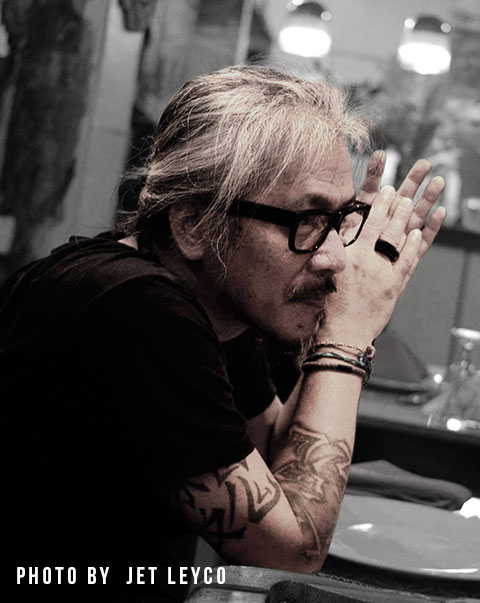
A deep dive on Lav Diaz, the man and the work in one read. Facts of life and filmography are stated from sources; bolder historical readings are given throughout as Diaz’s own statements. Read the director's statement
Back to the film